 Tiny Hearts CPR
Can you be sued for doing CPR in Indiana?
The second most common question in every class, answered properly rather than reassuringly.

Indiana has Good Samaritan provisions, found at Indiana Code 34-30-12, that protect people who provide emergency care in good faith, without compensation, at the scene of an emergency. The purpose of the statute is exactly the fear that prompts the question: legislators recognized that people who are afraid of being sued do nothing, and that doing nothing kills people. Nobody can promise that no lawsuit will ever be filed about anything. What the law does is protect the ordinary bystander who steps in and tries.
Why this question comes up in every single class
Because it is a reasonable fear, and because it is usually the polite version of a different fear. Underneath "can I be sued" is almost always "what if I make it worse". Both deserve a straight answer rather than reassurance.
On making it worse: a person in cardiac arrest is not breathing and has no pulse. There is no worse. That is the floor. Everything you do from there is upside, and the only intervention with a guaranteed bad outcome is the one where nobody does anything until the ambulance arrives.
What the protection generally depends on
- Good faith. You are trying to help, not experimenting or acting recklessly.
- No compensation. You are a bystander, not someone being paid for this care at that moment.
- Emergency circumstances. The protection is about emergency scenes, not ongoing care you decide to provide afterwards.
- Acting within reason. Doing what a reasonable untrained or trained person would do, and stopping when someone qualified takes over.
The exact wording, and the exceptions, live in the statute itself. This page is a plain language summary and not legal advice. If you have a specific concern, particularly a professional one, talk to a lawyer rather than a CPR instructor.
If you have a duty to act, the analysis is different
Healthcare professionals, and people whose job description includes responding, sit in a different position from a stranger in a garage. If that is you, know your own obligations and your employer's policy. Your training belongs in BLS for healthcare providers rather than a lay course.
Broken ribs are not a mistake
This is worth saying plainly because people carry it around. Compressions that go deep enough to circulate blood are compressions that can crack ribs, particularly in older adults. That is a known and accepted consequence of effective CPR, not evidence of error. Ribs heal.
For infants the depth question is its own subject, covered in infant CPR depth and rate, where the usual error runs the other way and people press far too gently.
When do you stop?
When the person starts breathing normally, when emergency services or someone qualified takes over, when the scene becomes unsafe for you, or when you are physically unable to continue. Handing over cleanly, and what to tell the crew when they arrive, is part of what gets rehearsed in a CPR party.
Reading this is not the same as training
This page exists so the information is in your head before you need it. It is not a substitute for putting your hands on a manikin with an instructor watching. Skills fade, and the difference between knowing the steps and being able to do them under adrenaline is practice. If you are in Indianapolis, book a class. If you are not, find an AHA or Red Cross class near you.
Source: Indiana Code 34-30-12. This page is general information about Indiana law, not legal advice.
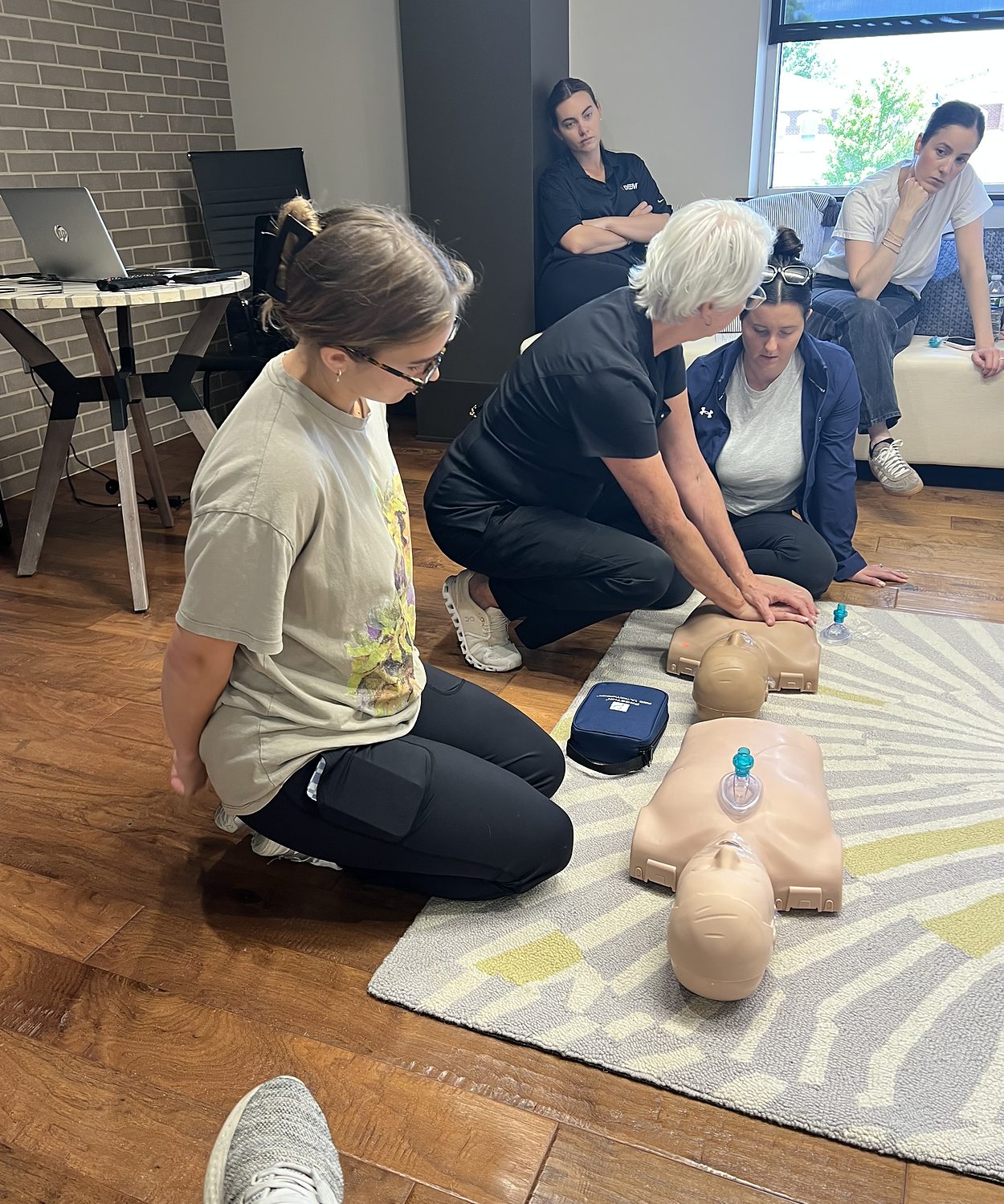
Reading gets the sequence into your head. It does not get it into your hands.
Every person in the room does every skill with their own hands, on a manikin, with a nurse watching and correcting. That correction is the part you cannot get from a page.
Legal questions
Can I be sued for performing CPR on someone?
Indiana's Good Samaritan provisions, at Indiana Code 34-30-12, protect people who give emergency care in good faith and without compensation. The protection is why the law exists: to stop fear of liability from producing bystanders who do nothing.
What if I break the person's ribs?
Rib injury during effective compressions is common and is not evidence that you did something wrong. Compressions deep enough to move blood are compressions deep enough to cause injury, and that trade is the entire point.
Does the protection apply if I am a nurse?
The analysis is different for people with a duty to act or who are being paid. If you are a healthcare professional, know your own obligations rather than assuming a general statute covers you.
What if I start and then stop?
Stop only when the person recovers, when someone qualified takes over, when it becomes unsafe to continue, or when you physically cannot go on. Pam covers this in class.
The next thing worth knowing.
Infant CPR depth, rate, and what changed in 2025
Read thisChokingWhat to do when a baby is choking
Read thisChoosingWhich CPR certification do you actually need?
Read thisReading is not training. When you want the hands on version, Pam teaches it in your own living room. See CPR parties, or call or text Pam at 317-820-8003.